
Why do we get injured? goPhysio, Chandlers Ford
We often hear, I haven’t done anything different, so why do I have an injury?
Why can one person run, lift or garden without a problem, while another develops pain doing something they have done many times before?
The simple answer is that injuries usually occur when the demands placed on the body exceed what it can currently tolerate. This can happen because the demand suddenly increases, the body’s capacity temporarily decreases, or an accident directly damages the tissues. It is rarely just one thing.
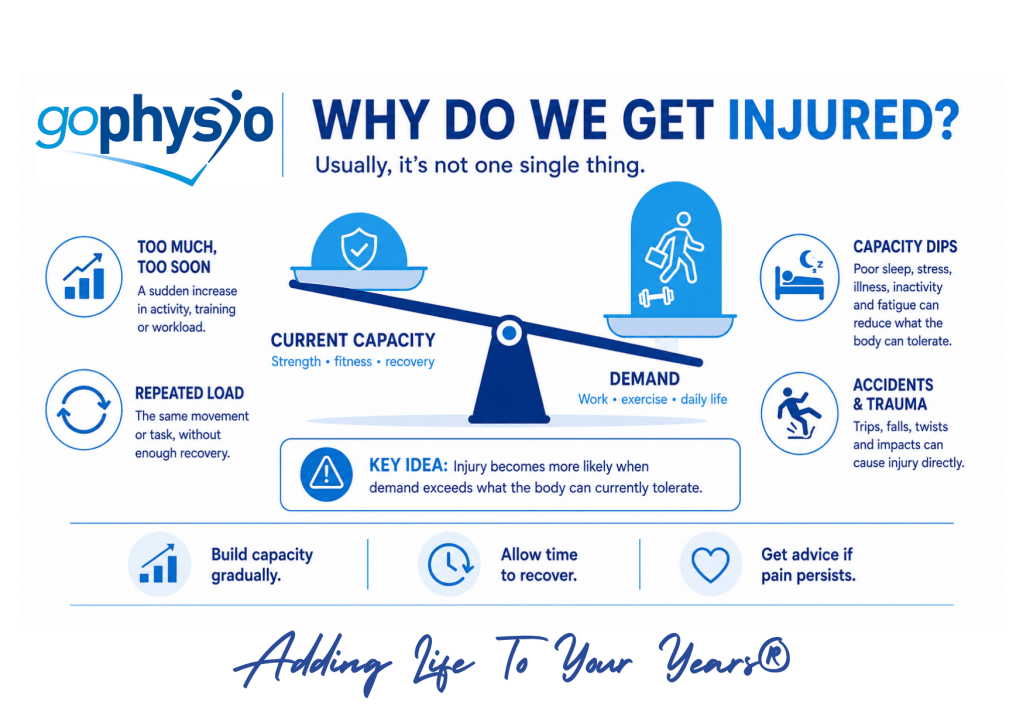
Work, exercise, household tasks, sleep, stress, illness, recovery and previous activity levels can all influence the balance between demand and capacity.
Why do injuries happen?
Injuries generally happen in one of two ways:
- A sudden injury: A fall, collision, twist or impact places more force on a tissue than it can withstand at that moment.
- A gradual or overload injury: Repeated or increased activity accumulates faster than the body can adapt and recover.
A sprained ankle after stepping off a kerb is an example of sudden trauma. An aching Achilles tendon after increasing your marathon training schedule too quickly is more likely to be a gradual overload problem.
Some injuries are unavoidable. However, understanding the balance between demand and capacity can help us reduce the likelihood of many injuries, and support a stronger, more lasting recovery when they happen.
What do “load” and “capacity” mean?
Load is the total demand being placed on your body. It doesn’t have to be anything particularly demanding or heavy. It can include:
- Exercise, sport and training
- Walking, running or cycling
- Lifting and carrying
- Physical or repetitive work
- Gardening and DIY
- Caring for children or relatives
- Long periods sitting or standing
- Any new or unusually demanding activity
Capacity is what your body can currently tolerate. Capacity is influenced by factors such as:
- Strength
- Fitness
- Mobility
- Previous activity levels
- Tissue health
- Sleep and recovery
- Illness
- Fatigue
- Stress
- Previous injury
- General health
Your capacity is not fixed. It can improve through regular activity and progressive strengthening, but it can also temporarily reduce.
This means an activity you normally manage comfortably may feel very different after illness, several disrupted nights, a stressful period or a break from exercise.
1. Doing too much, too soon
A sudden increase in activity is one of the most common reasons people develop pain or injury. This does not only apply to athletes. It might happen when you:
- Return to the gym after several months away or after a holiday
- Rapidly increase your running distance or speed
- Spend an entire weekend gardening
- Start a physically demanding job
- Walk much further than usual while on holiday
- Move house and repeatedly lift heavy boxes
- Begin a new fitness challenge
- Return to activity after illness or injury
The activity itself may be perfectly reasonable. The problem is often the size or speed of the change. The body adapts when it is challenged, given time to recover and then gradually challenged again. If the increase is greater than your current capacity, pain or injury becomes more likely.
2. Repeating the same load without enough recovery
Not every injury follows one dramatic event. Symptoms can build gradually when the same area is repeatedly loaded without sufficient variety or enough recovery. Repetitive activities may include typing, decorating, lifting, gripping, running or using tools. The NHS notes that repetitive strain symptoms may be influenced by a combination of factors – not simply one activity or supposedly “bad” movement. Here’s the NHS guidance on repetitive strain injury
You might tolerate the task well initially, but its cumulative effect can become greater than the body is currently prepared for. This does not necessarily mean you must stop the activity completely. The solution may involve temporarily adjusting the amount, frequency or intensity while building the strength and capacity needed to manage it.
3. Your capacity has temporarily reduced
Sometimes the load has not changed, but your ability to tolerate it has. Capacity can dip because of:
- Poor or reduced sleep
- Illness or fatigue
- A particularly stressful period
- Reduced activity
- Time away from exercise
- Inadequate recovery
- A previous or unresolved injury
- Changes in general health
Sleep, stress and fatigue do not automatically cause an injury. However, they can affect recovery, pain sensitivity, energy and how well the body manages physical demands. Research has found an association between persistently poor sleep, musculoskeletal pain and sports injury risk. You can read the review of sleep and injury risk here. This helps explain why a familiar activity can occasionally trigger symptoms even though you have done it many times before.
4. Accidents and direct trauma
Some injuries are much more straightforward. Trips, falls, tackles, collisions, sudden twists and direct impacts can create enough force to damage a muscle, tendon, ligament, joint or bone. These injuries are not necessarily caused by weakness, poor fitness or something you did wrong. Sometimes accidents simply happen.
However, your underlying strength, balance and physical capacity can influence how well you withstand an unexpected force and how successfully you recover afterwards.
Does pain always mean that something is damaged?
No. Pain and injury are related, but they are not the same thing. Pain is the body’s protective alarm system. It can be influenced by tissue irritation or damage, but also by previous experiences, stress, sleep, fatigue and how safe or threatening a movement feels. This is why:
- Significant pain does not always mean significant damage
- Some injuries initially cause surprisingly little pain
- A painful movement is not automatically a harmful movement
- Pain may continue after the original tissue has healed
- Scans do not always explain how much pain someone is experiencing
It is important to take pain seriously, but it does not always mean you should stop moving completely. The NHS advises that gradually increasing gentle activity is unlikely to cause damage for most persistent pain problems and can help the body become fitter and more capable. Read the latest NHS advice on activity and pain. The right approach depends on the individual injury, symptoms and circumstances.
Why can the same activity injure one person but not another?
Everyone starts with a different level of capacity. Two people may complete exactly the same activity, but their bodies may have different levels of strength, conditioning, recovery and previous exposure to that task. For example, a five-mile walk might be:
- A normal daily activity for one person
- A manageable challenge for another
- A very significant increase for someone recovering from illness or usually walking much shorter distances
This does not mean one body is “good” and another is “bad”. It simply means the demand is different relative to each person’s current capacity. That is also why rehabilitation and injury-prevention advice should be individual rather than based on a one-size-fits-all programme.
Can injuries be prevented?
It is impossible to prevent every injury, but it is possible to reduce risk. Helpful principles include:
1. Build activity gradually
Allow your body time to adapt when starting something new or returning after a break. Avoid increasing frequency, duration and intensity all at once. Avoid doing too much, too soon or too quickly!
2. Develop strength and fitness
Regular physical activity and strengthening increase your capacity to manage the demands of everyday life, work and sport. If you have a good baseline of strength and fitness, your overall capacity will be better. Physical activity also provides a huge range of other benefits for health, sleep, mood and long term independence.
3. Make room for recovery
Recovery is part of progress. Sleep, rest days and lighter periods give your body time to respond and adapt. Make sure you make time for recovery too.
4. Add variety
Changing position, movement or activity can help distribute load rather than repeatedly placing the same demand on one area. This applies to both more demanding and dynamic activities like sports and also more sedentary activities, like sitting.
5. Respond to early warning signs
Persistent or worsening pain, swelling, weakness or reduced function may indicate that your current load needs adjusting. Early advice can stop a manageable problem from becoming a longer-term frustration.
6. Avoid complete rest for too long
A short period of reduced activity can be useful after some injuries, but prolonged avoidance can reduce strength, confidence and capacity. The aim is usually to find a manageable level of movement and build from there. This is where the right support and advice is so important.
How can physiotherapy help?
A physiotherapy assessment is not only about identifying where it hurts. It should help answer:
- What may have caused or contributed to the problem?
- Is there evidence of a specific injury?
- What can you safely continue doing?
- What needs to be temporarily adjusted?
- Which areas of strength, mobility or balance need improving?
- How can progress be measured?
- What is needed to return to your normal activities confidently?
At goPhysio, we combine a thorough assessment with objective measures where appropriate. Measuring factors such as strength, balance and movement gives us a clearer starting point and allows us to track meaningful progress – not just whether the pain has changed. Your treatment and rehabilitation plan can then be matched to your injury, current capacity and the real-life demands you want to return to.
Our dedicated exercise rehabilitation service and Strong Room also provide a supportive environment in which to rebuild strength and confidence gradually.
When should you seek advice about an injury?
Consider arranging an assessment if:
- Pain is not improving
- Symptoms are becoming more frequent or intense
- The same injury keeps returning
- Pain is affecting sleep, work or everyday life
- You have lost strength, movement or confidence
- You are unsure whether it is safe to continue exercising
- You need help returning to work, sport or a valued activity
Seek urgent medical advice following a significant accident, or if you experience severe pain, obvious deformity, an inability to bear weight, rapidly increasing swelling, new numbness or weakness, or feel seriously unwell.
The key message
We are more likely to become injured when the combined demands of work, exercise and daily life exceed what our body can currently tolerate.
That may happen because the load has suddenly increased, the same load has been repeated without enough recovery, our capacity has temporarily reduced, or we have experienced an accident. Injury is therefore rarely about one “bad” movement or a single weakness.
By understanding your starting point, adjusting load where necessary and gradually building strength and capacity, you can recover more confidently and become better prepared for the activities that matter to you.
If pain or injury is getting in the way of your life, the goPhysio team in Chandler’s Ford can help you understand what is happening and create a clear, personalised recovery plan.
Book a physiotherapy assessment and take the first step towards moving with greater confidence.
Frequently asked questions
What is the most common reason people get injured? There is not one universal cause. Many injuries occur when physical demand increases more quickly than the body can adapt. Current strength, fitness, recovery, sleep, health and previous activity all influence how much load someone can tolerate.
Can stress cause an injury? Stress does not usually cause a physical injury by itself. However, it may affect sleep, recovery, muscle tension, pain sensitivity and energy, which can influence how you respond to physical demands.
Can poor sleep increase injury risk? Poor sleep does not guarantee that you will become injured, but consistently inadequate sleep may affect recovery, concentration and physical performance. It is one of several factors that can influence capacity and injury risk.
Is rest the best treatment for an injury? It depends on the injury. A short period of protection or reduced activity may be appropriate, particularly following acute trauma. However, complete rest for too long can reduce strength and capacity. Most rehabilitation involves a gradual, appropriately managed return to movement.
How do I know whether pain is an injury? Pain alone cannot always tell you whether tissue has been damaged. The nature of the symptoms, how they started, the effect on movement and function, and the findings from a clinical assessment all help determine what may be happening.
Can physiotherapy help prevent another injury? Physiotherapy cannot guarantee that an injury will never recur. It can identify relevant contributing factors, help restore movement and strength, guide a gradual return to activity and give you a clearer understanding of how to manage future changes in load.
Written by Paul Baker MCSP, goPhysio Clinical Director.