
Children’s Sports Injuries: Causes and Prevention | goPhysio
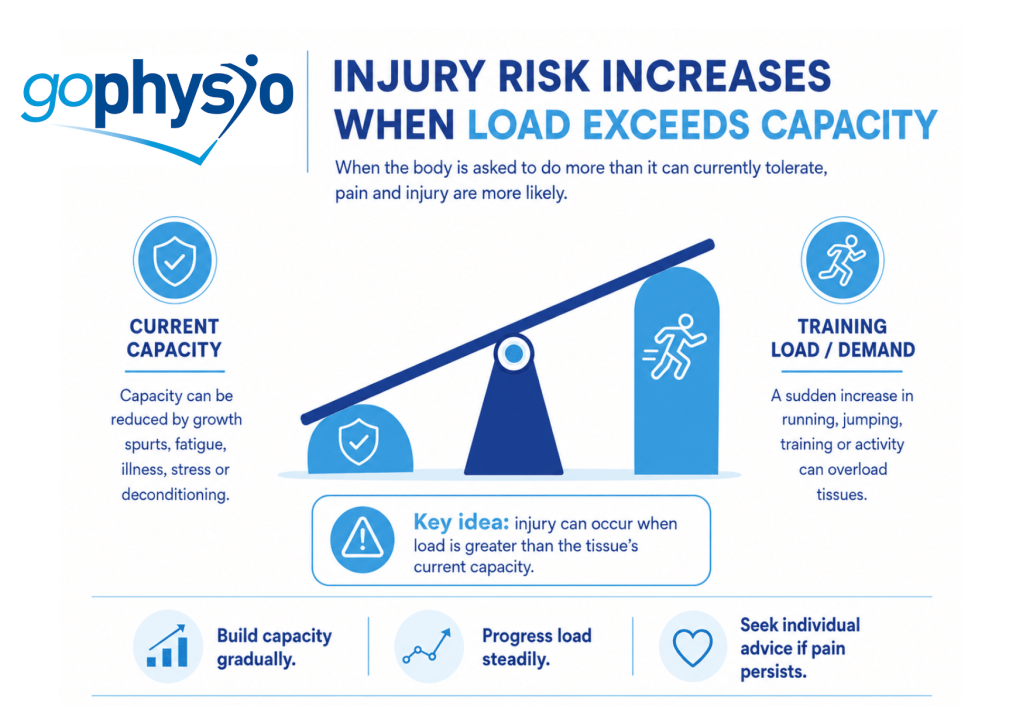
Children and teenagers can develop sports injuries when the physical demands placed on their bodies temporarily exceed what their muscles, bones and tendons are ready to tolerate.
This does not always mean they are playing “too much” sport. Injuries are often caused by a combination of factors, including a sudden increase in activity, a growth spurt, insufficient recovery, tiredness, stress, reduced strength or returning to sport too quickly after a break.
Understanding these factors can help parents and young athletes recognise problems early, reduce the risk of injury and make better decisions about training and recovery.
Why are growing children more vulnerable to sports injuries?
Children are not simply smaller versions of adults. Their bones, muscles, tendons and coordination are continually changing as they grow.
During childhood and adolescence, a young person may be able to cope comfortably with a certain amount of sport one month but find the same schedule much harder a few months later. This is particularly common during rapid periods of growth, when:
- Bones may grow faster than muscles and tendons can adapt
- Muscles can temporarily feel tighter
- Balance and coordination may change
- Tendon attachment points around growing bones can become sensitive
- More energy is being used for growth
- The body may need additional recovery
Growth itself does not automatically cause an injury. However, it can temporarily change how much exercise a young body can comfortably tolerate.
The balance between activity and capacity
One useful way to understand sports injuries is to think about the balance between physical demand and the body’s current capacity. Physical demand includes:
- Sports training
- Matches and competitions
- School PE
- Running, jumping and playground activity
- Strength and conditioning
- Dance, gymnastics or martial arts
- Activity completed for more than one team or club
Capacity describes how well the body is currently able to cope with those demands. A child’s capacity can be influenced by:
- Their recent training history
- Growth and physical development
- Previous injuries
- Strength and movement control
- Sleep and recovery
- Nutrition and energy intake
- Illness
- Schoolwork, exams and emotional stress
When activity increases suddenly or capacity temporarily falls, aches, pains and injuries can develop.
1. A sudden increase in sport or exercise
A rapid change in activity is one of the most common reasons children and teenagers develop overuse injuries. This may happen when a child:
- Returns to training after the school holidays
- Starts a new sporting season
- Joins an additional team
- Moves into a more competitive squad
- Suddenly has more matches or tournaments
- Returns after illness or injury
- Begins training at a higher intensity
- Changes position, playing surface or equipment
The problem is not necessarily the total amount of sport. It is often the difference between what the child has been doing recently and what they are suddenly being asked to do.
For example, a young footballer who has remained active throughout the summer may cope well with returning to training. Another child who has completed very little running for six weeks may find the same session much more demanding.
Help your child build up gradually
Before a new term or season, look ahead at their sporting calendar and gradually reintroduce the movements they will need.
Avoid scheduling several demanding sessions on consecutive days immediately after a break. Allow time for the body to adapt before adding more speed, distance, jumping or competition.
There is no single percentage increase that is safe for every child. Their age, stage of development, sport, recent activity and response to exercise all need to be considered.
2. Growth spurts
Rapid growth can be a challenging time for young athletes. Some children move through growth spurts without any difficulty. Others experience temporary tightness, reduced coordination or pain around the knees, heels, hips and other areas where tendons attach to growing bones. Common growth-related conditions include:
- Osgood-Schlatter disease at the front of the knee
- Sever’s disease at the heel
- Sinding-Larsen-Johansson syndrome below the kneecap
- Irritation around the hip or pelvis
- Bone stress injuries
You may notice that your child has suddenly become less coordinated, appears tighter than usual or finds movements they previously performed easily more difficult.
They do not necessarily need to stop all sport during a growth spurt. However, their training may need to be temporarily adapted if they are becoming increasingly sore, tired or frustrated.
3. Not enough recovery
Training is only one part of becoming fitter and stronger. The body also needs enough time and energy to recover and adapt. A child may be more vulnerable to injury when they are:
- Sleeping poorly
- Training hard on consecutive days
- Recovering from illness
- Not eating enough for their activity level
- Managing school or exam pressure
- Feeling emotionally stressed
- Frequently travelling to training or competitions
- Playing for several clubs at the same time
A training session that normally feels manageable may feel much harder when a child is tired, stressed or under-fuelled.
Look at the whole week
When considering how active your child is, include more than their main sport. A week might contain school PE, lunchtime football, club training, a match, athletics, dance and active time with friends. Each activity adds to the overall physical demand placed on their body. Keeping a simple weekly calendar can help parents identify particularly demanding days and avoid repeatedly placing the hardest sessions together.
4. Always training at maximum effort
Some children approach every training session as though it is a final or championship match.
They may be highly motivated, competitive or worried that reducing their effort will disappoint a parent or coach. Others may need to work harder than their teammates to keep up because of differences in size, maturity or experience. Working at maximum effort every day is difficult to sustain. Young athletes need a mixture of:
- Easier technical sessions
- Moderate training
- Strength and movement work
- Higher-intensity sessions
- Matches or competitions
- Recovery days
Even professional athletes do not train at their maximum intensity every day. Parents and coaches can help by praising good decision-making, communication and consistency—not only maximum effort or winning.
5. Previous injuries and incomplete rehabilitation
A previous injury can increase the risk of another problem, particularly if the child has returned to sport before fully recovering their strength, balance, confidence and sports-specific fitness. Being pain-free during everyday activities does not always mean a child is ready for full training or competition. Before returning to sport, they may need to demonstrate that they can safely:
- Run and change direction
- Jump and land
- Accelerate and slow down
- Balance on the affected leg
- Complete sport-specific movements
- Tolerate training without symptoms worsening afterwards
A structured rehabilitation programme can help bridge the gap between feeling better and being genuinely ready to return to sport.
6. Reduced strength or movement control
Strength helps growing bodies absorb and tolerate the forces produced during running, jumping, throwing and changing direction. Age-appropriate strength and movement training can help young people improve:
- Balance
- Coordination
- Landing technique
- Control when changing direction
- Muscle strength
- Confidence
- Physical resilience
Children can participate in supervised strength training when exercises are appropriate for their development and taught with good technique. The priority should initially be learning fundamental movements such as squatting, lunging, pushing, pulling, jumping and landing. Resistance can then be introduced gradually according to the child’s competence rather than using age alone.
7. Focusing on only one sport
Playing a variety of sports can expose children to different movements and physical skills. Specialising in a single sport from a young age may lead to the same areas of the body being repeatedly loaded throughout the year. It can also reduce opportunities to develop a broader range of movement skills.
This does not mean every young athlete must regularly change sports. However, variety, seasonal breaks and periods of less structured activity can be valuable – particularly before puberty. Most importantly, children should continue to enjoy being active rather than feeling that every session is part of a performance programme.
Signs your child may not be coping with their current activity
Children do not always clearly explain when something is wrong. Parents may instead notice changes in mood, movement or enthusiasm. Possible warning signs include:
- Repeated aches or “niggles”
- Pain that returns during every session
- A limp or change in running style
- Persistent muscle soreness
- Regular tiredness
- Poor sleep
- Recurrent illness
- Reduced performance
- Irritability or mood changes
- Anxiety about training
- Loss of enthusiasm for a sport they normally love
- Difficulty concentrating
- An irregular or absent menstrual cycle in a teenage athlete
One isolated difficult day is not usually a cause for concern. A repeated pattern suggests that the child’s training, recovery, health and nutrition should be reviewed.
A simple pre-training check
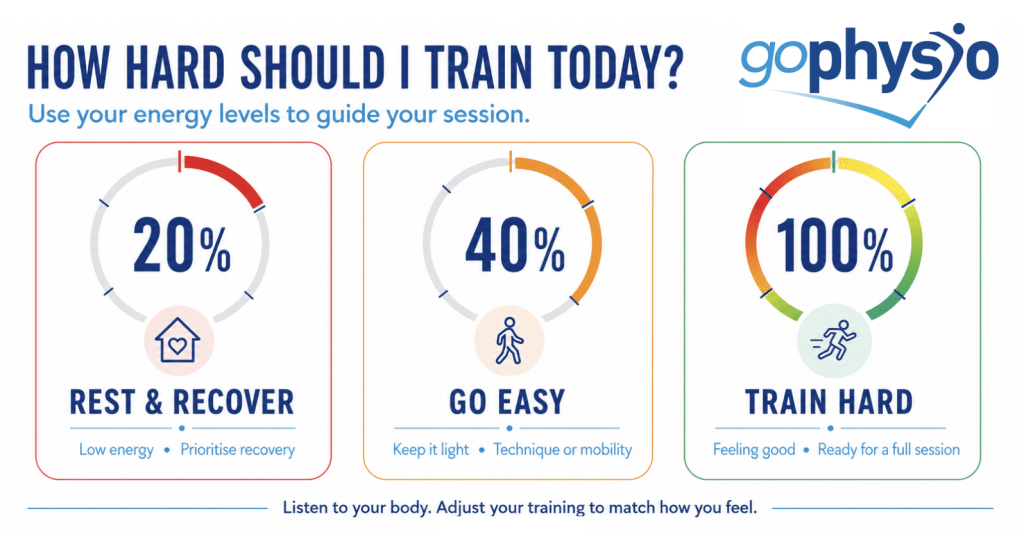
Before training, encourage your child to consider three questions:
- How tired do I feel?
- How sore does my body feel?
- How stressed or overwhelmed do I feel?
Their answers can help guide the day’s activity.
Feeling good
If they feel energetic, comfortable and motivated, they may be ready for a more demanding session.
Feeling somewhere in the middle
If they are slightly tired or sore, they may benefit from reducing the intensity and concentrating on technique, tactics or controlled movement.
Feeling unwell, exhausted or very sore
Rest or an alternative recovery activity may be more appropriate. Missing or modifying one session can be far better than developing an injury that prevents participation for several weeks.
Seven ways to reduce sports injury risk in children
1. Plan for changes in activity
Build up before a new term, season, tournament or sports camp rather than going from very little activity to several intense sessions.
2. Include recovery days
Avoid placing every high-intensity session on consecutive days. Recovery does not have to mean doing nothing; walking, gentle cycling or easy mobility work may be suitable.
3. Prioritise sleep
Young athletes need enough sleep to support growth, learning, recovery and general wellbeing. Persistent morning tiredness may indicate that their current routine needs adjusting.
4. Provide enough food and fluid
Growing athletes need energy for both their sport and normal development. Food intake may need to increase on longer or more demanding training days.
Concerns about weight loss, restrictive eating, repeated illness, disrupted periods or ongoing fatigue should be discussed with an appropriate healthcare professional.
5. Develop strength and movement skills
A supervised programme that includes strength, balance, jumping, landing and change-of-direction skills can help prepare children for the demands of their sport.
6. Encourage honest communication
Children should feel able to tell parents and coaches when they are tired, sore or struggling without worrying that they will be criticised or dropped.
7. Respond to pain early
Pain is often easier to manage when it is assessed early. Repeatedly pushing through pain can turn a manageable problem into a longer-term injury.
Should children continue playing sport when they have pain?
The answer depends on the cause, severity and behaviour of the pain.
Some mild symptoms can be managed by temporarily adapting activity rather than stopping sport completely. However, a child should not be encouraged to push through worsening pain, compensate with a limp or repeatedly rely on pain relief simply to participate. An assessment can help establish:
- What is causing the pain
- Whether the condition is related to growth, overload or an injury
- Which activities can safely continue
- What needs to be temporarily reduced
- Which exercises will support recovery
- How to return to full sport safely
When should you seek urgent medical advice?
Seek urgent medical help if your child:
- Cannot put weight through an arm or leg
- Has severe pain following an injury
- Has a limb or joint that looks deformed
- Develops substantial or rapidly increasing swelling
- Feels unwell or has a high temperature alongside a painful, hot or swollen joint
- Develops worsening symptoms following a head injury
- Has numbness, weakness or a significant loss of movement
For less urgent problems, arrange an assessment if pain persists, regularly returns with sport, affects sleep, causes a limp or stops your child enjoying their normal activities.
Children and teen sports injury support in Chandler’s Ford
At goPhysio, we help children and teenagers from Chandler’s Ford, Eastleigh, Southampton and Winchester recover from sports injuries, manage growth-related pain and return to their activities safely and confidently.
Our team takes time to understand the young person, their sport, weekly activity, stage of development and individual goals. Treatment may include education, activity advice, hands-on treatment and a progressive rehabilitation programme.
Members of our team have also completed additional Kids Back 2 Sport training in the assessment and management of musculoskeletal conditions and sports injuries in children and teenagers.
No GP referral is normally needed.
Worried about an injury or recurring pain? Book a children and teen sports injury assessment with goPhysio or call our friendly team on 023 8025 3317.

Frequently asked questions
Why does my child keep getting sports injuries?
Recurring injuries may be associated with rapid changes in training, growth, incomplete rehabilitation, insufficient recovery, reduced strength or a mismatch between the child’s activity and current physical capacity. An assessment can help identify the most relevant factors.
Are sports injuries common during growth spurts?
Some injuries become more common during rapid growth because the body is changing quickly. Tendon attachment points can become sensitive, coordination may temporarily change and the child may need more recovery. However, not every child develops pain during a growth spurt.
How much sport is too much for a child?
There is no single safe number of hours for every child. The appropriate amount depends on their development, recent training, sport, intensity, recovery and response to activity. Sudden changes and a persistent lack of recovery are often more important than the total number of hours alone.
Can children lift weights safely?
Yes. Properly supervised, age-appropriate resistance training can be safe and beneficial. Children should first learn good movement technique, with resistance added gradually according to competence.
When should my child see a physiotherapist?
Consider arranging an assessment if pain repeatedly occurs during sport, lasts beyond several days, causes a limp, affects normal movement, reduces performance or makes your child reluctant to participate. Seek urgent medical help for severe pain, deformity, substantial swelling, inability to bear weight or signs of illness.